
1.800.668.3752
Call us for a free quote
Call us for a free quote
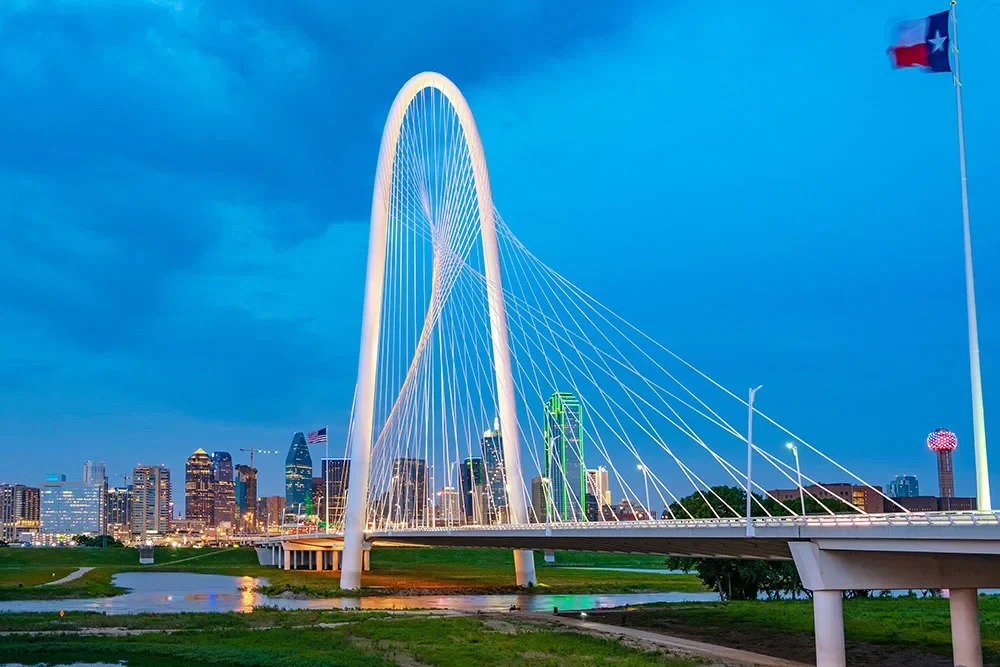
For the seventh year running, Dallas-Fort Worth is the number one metro in America for corporate headquarters relocations. CBRE’s 2026 Shifting Landscape of Headquarters Relocations report, released in April, confirms what anyone watching the North Texas skyline already suspected: the companies aren’t stopping.
In 2025 alone, DFW landed 11 interstate or international HQ relocations — more than any other U.S. metro, and ahead of Miami (8), Austin, Charlotte, and New York (7 each). Another seven companies executed intrastate moves within the region, consolidating operations or upgrading into buildings with better amenities. Since 2018, DFW has captured more than 100 headquarters relocations — the most of any U.S. metropolitan area across CBRE’s seven-year dataset.
The national story matters, too. HQ relocation activity grew more than 70% from 2024 to 2025 as corporate mobility accelerated. And DFW didn’t just keep pace — it stayed on top.
CBRE’s data identifies four roughly equal top reasons for relocations in 2025: consolidating operations and portfolio optimization (34 moves), business climate including taxes and cost of living (27), real estate advantages like building amenities and lower cost (27), and access to the consumer base (27).
DFW happens to check every box. That’s why the region keeps winning.
No state income tax and a genuinely pro-business climate. Texas consistently ranks among the most business-friendly states in the country, and the absence of state or local income tax remains one of the first lines on any site selector’s spreadsheet. For companies leaving California, Illinois, or New York — and nearly all 11 of DFW’s 2025 interstate wins came from exactly those high-cost markets — the math is straightforward.
A deep, diverse talent pool. CBRE noted that “Labor Availability” surged as a relocation driver in 2025, replacing the narrower “lower-cost tech talent” trend that dominated 2021-2023. DFW’s workforce spans finance, healthcare, technology, logistics, manufacturing, and professional services — which is why companies as different as KFC U.S., Care.com, FiberLight, and Aerolane all chose the region in the past year.
Central geography and infrastructure. Two major international airports, a central U.S. time zone, and a logistics backbone that connects both coasts make DFW a natural fit for companies operating nationally. It’s also one of the few large metros where land is still available for the kind of build-to-suit campuses that major HQ moves require — Goldman Sachs’ 800,000-square-foot Dallas regional campus being a recent example.
Room to consolidate and right-size. This is the under-reported piece. Seven of DFW’s 2025 HQ moves were intrastate — companies already in the region relocating to consolidate operations or upgrade into better space. CBRE describes this as “rightsizing their footprints,” and it’s a national pattern: companies are increasingly choosing smaller, smarter, amenity-rich buildings over legacy large-floorplate offices. For companies moving within the region, blending existing furniture with new and pre-owned pieces is often the fastest way to right-size without starting from scratch — and lease-compliant liquidation and decommission services handle what doesn’t come along for the ride.
One of the most important themes in the 2026 CBRE report is how the HQ itself is changing. Companies are “intentionally downsizing square footage, shifting away from traditional large, centralized floorplates toward smaller and more flexible, efficient offices.” Desk sharing, flexible floors, and multifunctional collaboration hubs are replacing pre-pandemic footprints that were often two or three times larger.
The hub-and-spoke model is accelerating, too — a smaller central HQ supported by satellite offices closer to where employees actually live. For companies relocating to DFW, that often means a right-sized flagship space in Plano, Frisco, Las Colinas, or downtown Dallas, supported by smaller footprints across the region and into other Texas markets like Austin and San Antonio.
Cost efficiency is the stated driver, but the deeper logic is that the office is being re-scoped around what in-person work actually requires: collaboration, culture, client-facing moments, and focused work that benefits from being around other people. Everything else can happen elsewhere.
This has real implications for the offices these incoming companies are building.
Smaller square footage doesn’t mean less investment. In many ways, it means more — per square foot, per employee, and per design decision. When a company cuts 40% of its footprint, every remaining square foot has to work harder. Thoughtful space planning becomes the difference between a headquarters that works and one that doesn’t.
The headquarters being built in DFW right now tend to share a set of characteristics:
The decision to move to DFW is strategic. The decision about what to put inside the building is where the strategy gets executed — and where many companies either get it right or spend years trying to fix what they rushed. A structured process that pairs space planning with furniture selection up front tends to be the difference.
If you already operate in DFW, the 2026 CBRE data is worth paying attention to even if you aren’t planning a move. The companies relocating here are competing for the same talent you are, from the same labor pool, and they’re raising the bar on what a workplace is expected to offer. Employees who tour a new-to-DFW corporate headquarters with a reservation-based open floor plan, wellness suite, and flexible collaboration zones will come back to work with new expectations.
The good news: you don’t have to build a 200,000-square-foot campus to compete. The same principles driving Fortune 500 HQ design — flexibility, hospitality, technology integration, intentional brand expression — scale all the way down to a 3,000-square-foot office. What matters is whether the space is designed to support how your team actually works in 2026, not how offices were designed in 2015.
DFW is winning the HQ relocation race because the region delivers on the fundamentals. The companies thriving inside those headquarters — whether they just moved here or have been here for decades — are the ones who translate those fundamentals into the spaces their people show up to every day.
1. Why are companies relocating headquarters to DFW?
Companies move headquarters to DFW for lower taxes, business-friendly policies, access to talent, central U.S. geography, strong infrastructure, and lower operating costs compared with coastal markets.
2. How many companies moved headquarters to Dallas-Fort Worth in 2025?
According to CBRE’s 2026 report, DFW attracted 11 interstate or international headquarters relocations in 2025, the highest total in the nation.
3. What industries are moving headquarters to DFW?
Common industries include finance, healthcare, logistics, manufacturing, technology, consumer brands, and professional services.
4. Why is Dallas-Fort Worth beating other cities for HQ relocations?
DFW combines affordable real estate, airport connectivity, talent availability, no state income tax, and room for expansion — advantages many competing metros cannot match.
5. How is hybrid work changing corporate headquarters design in DFW?
Many companies are downsizing square footage while investing in flexible layouts, collaboration areas, hoteling desks, wellness spaces, and smarter technology integration.
6. What does HQ relocation growth mean for existing DFW businesses?
It increases competition for talent, raises workplace expectations, boosts commercial real estate demand, and creates opportunities for office design, furniture, and relocation vendors.
7. Is Dallas still the best city for corporate headquarters relocation?
Dallas-Fort Worth remains one of the strongest headquarters relocation markets in the U.S. due to its business climate, talent pool, and infrastructure.
8. Which DFW cities are attracting corporate headquarters?
Plano, Frisco, Las Colinas, downtown Dallas, Irving, and other North Texas business hubs continue attracting headquarters investments.